

Why Traditional Segmentation Keeps Missing the Mark
Let’s be honest: sorting doctors by zip code and script volume is a bit like trying to predict a marathon winner based solely on the brand of their shoes—it’s missing the actual runner. This article argues that traditional biopharma segmentation, which leans heavily on structural data (like specialty and decile rank), is fundamentally flawed because it ignores real-time intent. You’ll discover why a mid-decile physician who just researched a specific mechanism of action is a far more valuable target than a high-decile doctor who isn't currently seeing relevant patients. The core takeaway is a shift from what HCPs write to how they decide, using behavioral clustering to catch physicians at the exact moment they are ready to move. What to Expect: From Archetypes to Adoption You should expect to walk away with a clear understanding of the four psychological archetypes—Rapid Validators, Guideline Anchors, Peer-influenced Switchers, and Cautious Trialists—and the specific "friction points" that keep each from prescribing. The article warns that a "spray and pray" messaging strategy doesn't just waste impressions; it can actively entrench resistance by delivering efficacy data to a physician who actually needs risk mitigation tools. By the end, you'll see how PharmaServ facilitates "decision-aware engagement," a strategy that aligns every touchpoint with a physician's unique adoption journey rather than a rigid, outdated spreadsheet.
By the team at PharmaServ
2026-04-29T15:23:52+01:00
The Limits of Structural Data
Most HCP segmentation strategies in biopharma are built on structural data: specialty, decile rank, affiliation, and geographic territory. These variables are useful for defining the universe of potential targets, but they tell you almost nothing about who is ready to move right now.
A high-decile oncologist who is not currently seeing patients that fit your indication is not a high-priority target this month. A mid-decile physician who just attended a medical education event on your mechanism of action, and then searched for patient identification criteria, is. Decile does not capture that distinction. Behavioral clustering does.
How PharmaServ Maps Behavior to Strategy
Rather than grouping HCPs by what they write, behavioral clustering groups them by how they decide. This distinction is more than semantic, it fundamentally changes who gets prioritized, what message they receive, and when the engagement happens.
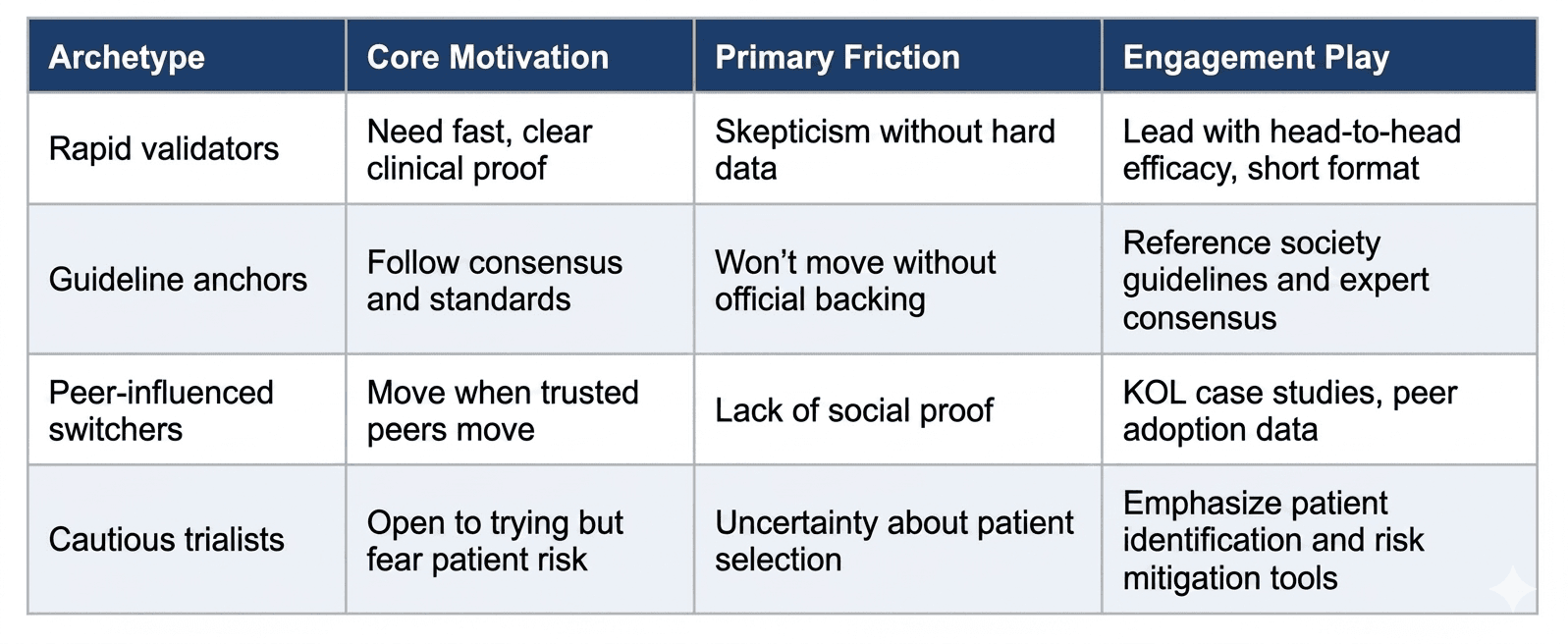
Across brands and therapeutic categories, a consistent set of archetypes tend to emerge. Each one carries a different core motivation, a different friction point that slows adoption, and a different engagement approach that moves them forward:
Misalignment Has a Cost
Each cluster requires a different message angle, a different channel approach, and a different cadence. A Rapid Validator does not need a peer adoption story , they need efficacy data, formatted for fast consumption. A Guideline Anchor will not move based on a KOL quote alone, they need to see your asset reflected in the frameworks they already trust. Confusing these archetypes does not simply result in a wasted impression.
Sending the same campaign to all four is not just inefficient , it actively slows adoption by putting the wrong message in front of the wrong physician at the wrong moment. Worse, it can entrench resistance. A Cautious Trialist who receives efficacy-first messaging before their concerns about patient selection are addressed may disengage entirely, making future outreach harder.
PharmaServ helps commercial teams move away from uniform campaign logic and toward decision-aware engagement , where every touchpoint reflects where a physician actually is in their adoption journey, not where a decile ranking suggests they should be.
Ready to see how behavioral clustering fits your commercial strategy? A short discovery call is all it takes.

PharmaServ helps pharma and life science sales teams boost productivity with AI-powered workflows, real-time HCP insights, and compliant engagement.
Drive more calls, grow prescriptions, and make every connection count.
Contact

+12369785171

info@pharmaserv.co

4178 Dawson Street Burnaby British Columbia, Canada. V5C 0A1
Support
Policy
Copyright ©2026 PharmaServ
.svg)
.svg)
.svg)
.svg)
.svg)
