
What AI Behavioral Insights Mean In 2026
What AI behavioral insights actually mean in 2026 for Life Science commercial leaders, and how PharmaServ turns HCP signals into NBRx strategy.
By the team at PharmaServ
2026-05-06T15:40:19+01:00
There is a lot of noise around AI in pharma commercial strategy right now. Most of it is about content generation or chatbot interfaces. That is not what we are talking about here.
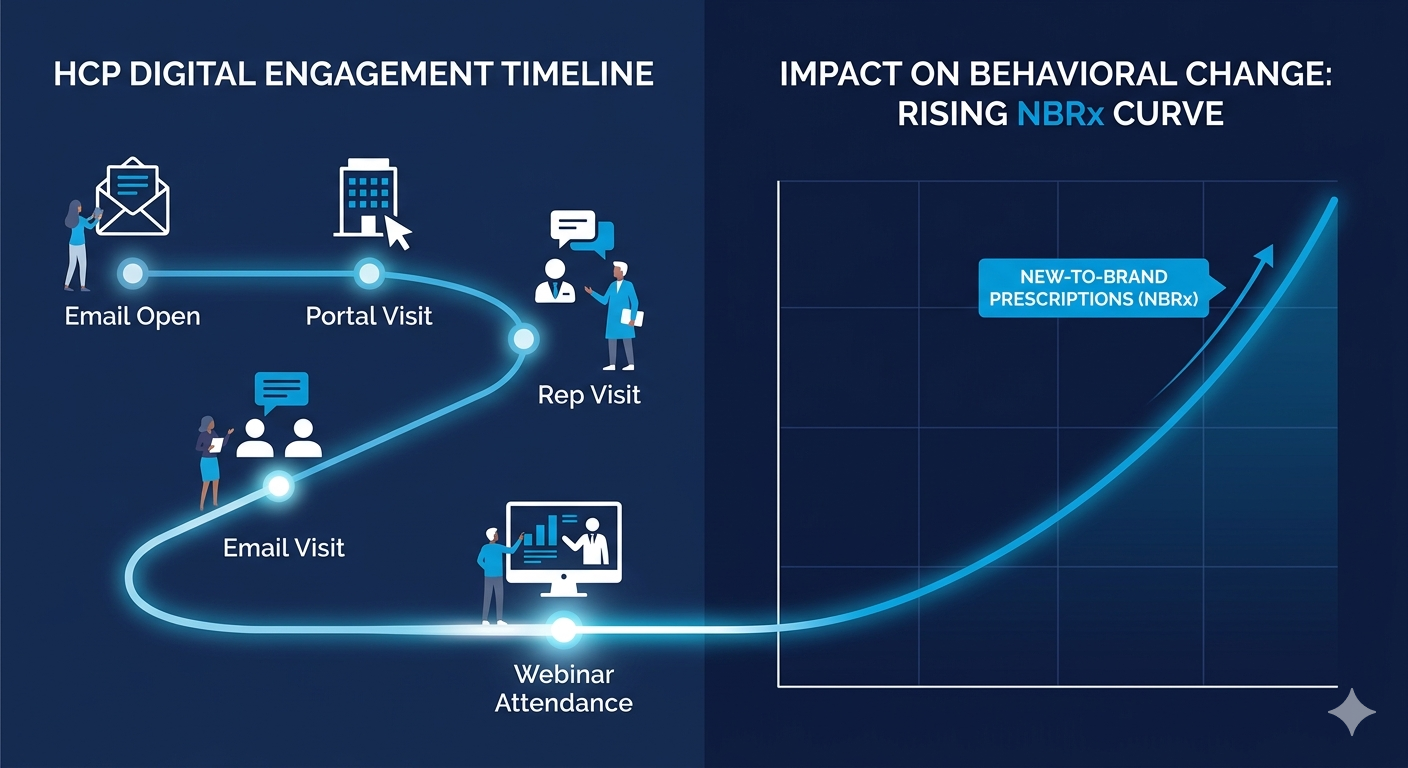
AI behavioral insights, as PharmaServ applies them, are patterns derived from how HCPs engage across channels over time. Engagement cadence, topic affinity, depth of interaction on specific clinical themes, response patterns to different message types, and sequence behaviors that correlate with movement toward NBRx.
These signals are not magic. They do not predict individual prescribing decisions with certainty. What they do is give commercial leaders a defensible, evidence-based basis for prioritization. Instead of allocating field and digital resources based on historical volume, teams can allocate based on current behavioral momentum.
Behavioral momentum matters because it tells you where an HCP is headed, not just where they have been. An HCP who is spending more time engaging with your mechanism of action content, asking deeper clinical questions, or returning to specific topics is showing signs of openness, and that is happening before a single script is written. Identifying those HCPs early and reaching them with the right message at that moment is what actually shortens time-to-NBRx.
What Behavioral Data Is, and What It Is Not
The term gets stretched in commercial conversations. Behavioral data is not the same as engagement analytics. Open rates, click-throughs, and session counts are metrics. They describe activity. Behavioral data describes intent, and the distinction matters because the two lead to completely different commercial responses.
A physician who opens a clinical summary email four times without clicking has not engaged in any meaningful way according to a standard engagement report. Behaviorally, that repeat-open pattern on a specific asset is worth investigating. It may indicate a physician working through a clinical question who has not yet found what they need.
In 2026, the Life Science companies pulling ahead in competitive therapeutic areas are the ones who have stopped treating these signals as background noise and started treating them as the primary input into their next-best-action models. The table below breaks down what the four main categories of behavioral data actually measure, and what each one tells commercial teams that a raw metric cannot.
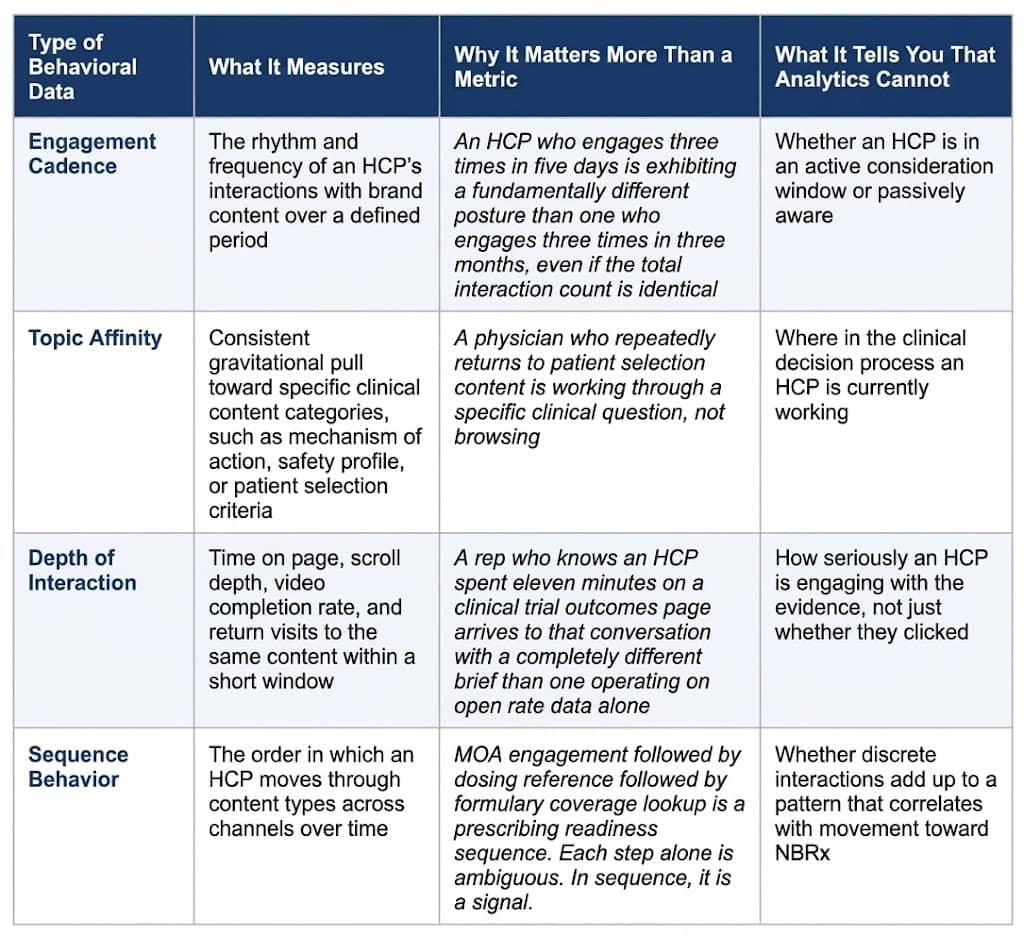
The four categories of behavioral data PharmaServ uses to build commercial signal from HCP engagement. Each type requires different collection logic and informs a different layer of the decision framework.
Understanding these four categories matters because each one requires a different collection approach, a different interpretation framework, and a different commercial response. Treating all behavioral data as a single input is one of the most common ways Life Science teams underinvest in the intelligence they are already sitting on.
Why Behavioral Insights and AI Content Tools Are Not the Same Conversation
When most commercial and marketing leaders hear AI in a pharma context today, they are thinking about content generation: AI-written emails, AI-assembled slide decks, auto-generated follow-up sequences. Those capabilities exist and have legitimate applications. But they answer a different question.
Content generation answers: what do we say? Behavioral insights answer: who is ready to hear it, what specifically are they working through, and which channel will reach them before the consideration window closes?
Conflating the two leads to a specific and common failure mode: highly personalized content delivered to the wrong HCP at the wrong moment because the targeting model was not built on behavioral signal. A well-written clinical email sent to a physician who is not in an active consideration window is not precision engagement. It is well-written noise.
PharmaServ separates these two layers intentionally. The behavioral insight layer informs the targeting and timing decisions. The content layer delivers on those decisions. Running both from the same platform with shared data is how the two capabilities compound each other rather than operate as disconnected point solutions.
What This Actually Changes About Resource Allocation
The most concrete way to understand what behavioral insights mean for a Life Science commercial team is to look at where they change a resource allocation decision.
Consider a territory with 80 HCPs on a target list. Under a volume-based allocation model, field resources concentrate on the top-decile prescribers, digital touches fill in the mid-tier, and lower-volume physicians receive minimal investment. That logic is not wrong. But it is operating on historical evidence, and it misses something important: the physician currently in the third decile who has spent the last three weeks engaging deeply with your clinical content is behaviorally ahead of several physicians in the first decile who have not opened anything since the last congress.
Behavioral momentum reorders that list in a way that historical volume cannot. The physician actively working through your evidence is closer to an NBRx prescription than their historical volume suggests. Acting on that signal, with the right message and at the right moment, is where time-to-prescription actually compresses.
The shift from volume-based to momentum-based allocation is not a technology decision. It is a strategic decision about which evidence your commercial team trusts when the data conflicts with the conventional wisdom about your target list.
This is why PharmaServ frames behavioral insights as a strategic decision intelligence layer rather than a reporting function. The output is not a chart of who engaged last week. The output is a ranked, signal-weighted view of which HCPs your commercial team should prioritize today, and why, with enough specificity that a field manager or brand director can act on it without needing to run their own analysis.
How Behavioral Insights Actually Shorten the Pathway to Prescription
Time-to-NBRx is not shortened by sending more communications. It is shortened by removing the lag between when an HCP becomes genuinely receptive and when your commercial team recognizes and responds to that receptivity.
That lag exists in every commercial operation that relies on scheduled rep cycles, static segmentation models, or quarterly data refreshes. A physician who enters an active consideration window on a Tuesday does not wait for the next scheduled rep visit. They engage with whatever clinical information is available to them, form a clinical impression, and begin making decisions. If your commercial team does not know that window opened, they miss the moment that most directly correlates with a first prescription.
Behavioral insight systems narrow that lag. PharmaServ's platform continuously indexes HCP engagement across digital and field channels, identifies pattern shifts that indicate a change in consideration status, and surfaces those shifts to the commercial team with enough context for an immediate response. The goal is not to alert a rep that an HCP visited your website. The goal is to tell a rep that an HCP has moved into a behavioral pattern that, across similar physicians in similar contexts, has preceded a first prescription within 30 days.
That level of specificity is what separates behavioral intelligence from behavioral data. Data describes what happened. Intelligence tells you what to do with it before the window closes.
The Standard This Sets for Commercial Teams in 2026
The HCPs who are going to write your first NBRx prescriptions next quarter are already engaging with clinical content right now. They are forming impressions, working through objections, and comparing options in the moments between rep visits and conference sessions. Whether your commercial team can see that activity, and act on it, is a function of whether your engagement infrastructure is built to capture behavioral signal or simply to deliver content.
In 2026, the difference between those two models is measurable in time-to-prescription, field resource efficiency, and brand adoption curves. PharmaServ is built for Life Science commercial teams who need the former, and who are ready to make resource allocation decisions based on where physicians are going rather than where they have been.
See how PharmaServ maps behavioral signal to your brand's commercial strategy at ca.pharmaserv.co

PharmaServ helps pharma and life science sales teams boost productivity with AI-powered workflows, real-time HCP insights, and compliant engagement.
Drive more calls, grow prescriptions, and make every connection count.
Contact

+12369785171

info@pharmaserv.co

4178 Dawson Street Burnaby British Columbia, Canada. V5C 0A1
Support
Policy
Copyright ©2026 PharmaServ
.svg)
.svg)
.svg)
.svg)
.svg)
