

10 Best Pharma CRM Software in Canada (2026 Edition)
Discover the best pharma CRM software in Canada for 2026. Compare 10 top platforms for PIPEDA-compliant HCP engagement and field execution.
By the team at PharmaServ
2026-06-23T17:34:54+01:00
Why Choosing the Best Pharma CRM Software in Canada Is a Different Buying Decision
The best pharma CRM software in Canada is not just a step above a regular CRM, it is a fundamentally different product category built for commercial teams operating in a regulated, relationship-driven industry. In Canada, that means contending with PIPEDA compliance requirements, provincial privacy variations, bilingual support needs across English and French markets, and data residency expectations that many global vendors will not address clearly until you are deep into a sales conversation.
A proper pharma CRM in 2026 covers HCP and HCO profiling, territory and call planning, compliant sampling workflows, event and campaign management, multichannel communication across email, SMS, and WhatsApp, e-detailing and CLM capabilities, and real-time analytics. If a platform cannot support most of those functions out of the box or with minimal configuration, it is not truly a pharma CRM regardless of what the vendor calls it.
This article covers 10 platforms worth shortlisting for Canadian teams, with honest strengths, real limitations, and a practical recommendation path at the end based on team size and commercial model.
How These Pharma CRM Platforms Were Evaluated for Canadian Teams (2026 Criteria)
Before getting into the list, here is the framework that shaped how each platform was assessed.
Canadian compliance and privacy: PIPEDA alignment, audit trails, role-based access controls, data encryption, consent capture processes, and documented breach response. Where vendor documentation was unclear, that uncertainty is noted because it matters at contract stage.
Data residency and hosting: Canadian-based server options where confirmed, or a vendor's documented ability to support Canadian data residency requirements.
Canadian support and onboarding: local presence or time-zone-aligned coverage, bilingual enablement where relevant, structured onboarding, and quality of training materials.
Field execution fit: territory planning, call scheduling, visit verification, offline access, mobile usability, and how quickly reps can log a completed call.
HCP engagement capabilities: e-detailing tools, approved content control, multichannel interaction tracking, and event management.
Integrations and ecosystem: SSO support (Azure AD, Okta), email and calendar sync, BI tool connections, ERP integration, and marketing automation compatibility.
Pricing transparency: whether tiers are published or quote-only, and what is typically included versus billed separately.
Time to value: a realistic picture of how quickly a Canadian field team can go live and start producing measurable output.
1. PharmaServ: Best Overall for Canadian Field Teams That Want AI and Omnichannel Execution
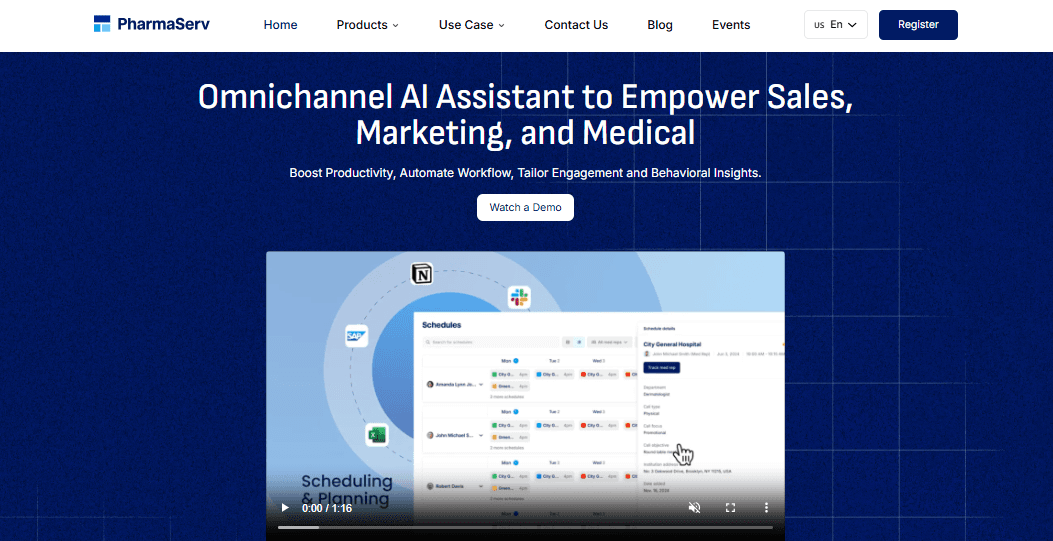
PharmaServ is built with Canadian pharma and life sciences teams in mind. Its platform brings AI-powered call planning, real-time HCP and HCO insights, multichannel engagement tracking, and GPS geo-fencing for field rep accountability into a single unified system. The PharmaServ Copilot module gives reps and managers real-time performance visibility, helping teams prioritize the right HCPs and carry out more productive visits while reducing the admin overhead that takes reps away from actual selling.
The Field Service Platform supports territory management, lead prioritization, order tracking, and visit scheduling, giving field reps a practical workflow tool rather than just another database to maintain. Headquartered in Burnaby, British Columbia, PharmaServ provides Canadian time-zone support and a genuine local focus that many global platforms cannot match.
Good fit for: teams launching a new brand, reactivating underperforming territories, scaling event campaigns without adding headcount, or teams that need stronger rep accountability through GPS-verified visit data.
Before signing: verify PIPEDA posture, data residency commitments, integration costs, and pricing structure in the vendor contract.
2. Veeva CRM: Best for Enterprise Life Sciences Teams Standardized on the Veeva Ecosystem
Veeva is the established category leader in pharmaceutical CRM. Its CLM capabilities, territory alignment tools, sampling support, and analytics ecosystem are mature and well proven in complex multi-brand commercial environments. For Canadian teams already operating within the Veeva stack, it offers reliable continuity and industry-standard compliance tooling.
The trade-offs are real: longer implementation cycles, higher total cost of ownership, and reduced flexibility for smaller or mid-market teams. Canadian organizations with complex governance requirements and a large field force get the most from Veeva. Confirm Canadian data residency options and local support coverage before beginning the procurement process.
3. Salesforce Health Cloud: Best for Teams That Need a Highly Customizable Platform
Salesforce's strength in pharma is its flexibility. With the right implementation partner or internal platform team, Health Cloud can be configured into a capable HCP engagement platform with strong workflow automation and integration options. The challenge is that it does not arrive pharma-ready.
Success depends heavily on implementation quality, which adds both time and risk. Canadian organizations with existing Salesforce infrastructure or a trusted SI partner get significantly more value from this route than teams starting from scratch. Assess Canadian data center options and PIPEDA-alignment in the architecture before signing.
4. IQVIA OCE: Best for Teams That Want CRM Tied to a Large Life Sciences Data Ecosystem
IQVIA OCE offers omnichannel CRM capabilities with direct access to IQVIA's broader data and analytics services. If your team is already purchasing IQVIA data, bundling OCE makes strategic sense and simplifies vendor relationships. For teams without that existing IQVIA relationship, the platform can feel heavy and complex to justify on its own.
Field workflows are solid and enterprise readiness is well established. Validate how Canadian HCP data workflows are handled and confirm what the local support model looks like before making a commitment.
5. Microsoft Dynamics 365: Best for Microsoft-First Organizations Wanting CRM and Workflow Automation
Dynamics 365 is a natural match for Canadian pharma teams already standardized on Microsoft's technology stack. Integration with Microsoft 365, Teams, and Power Platform is straightforward, and Canada's strong Microsoft partner network means implementation support is accessible across most provinces.
The gap is pharma-specific functionality. Compliant call planning, CLM, and sampling workflows require additional configuration or partner-built solutions on top of the base platform. Assess your team's internal capacity for ongoing platform administration before committing to this route.
6. Creatio: Best for Teams That Want Low-Code Flexibility Without Full Platform Complexity
Creatio offers a low-code CRM environment where commercial teams can build and automate custom workflows at a faster pace than most enterprise platforms allow. It suits mid-sized Canadian pharma or biotech organizations that need tailored processes without the cost and complexity of a full Salesforce implementation.
Pharma-specific capabilities like CLM and compliant sampling typically require third-party add-ons or partner integrations. Configure audit trails and governance controls carefully at setup to ensure regulated data handling meets internal standards.
7. HubSpot CRM: Best for Pharma-Adjacent Teams Focused on Inbound and Lead Nurturing
HubSpot serves Canadian biotech and pharma-adjacent organizations running content-led HCP engagement strategies rather than large field rep operations. Its marketing automation, email sequencing, pipeline tracking, and landing page tools are genuinely useful for education-driven growth and top-of-funnel HCP engagement.
Where it falls short is pharma field force specifics: territory management, call planning, e-detailing, and compliant sampling are not part of its core offering. Evaluate PIPEDA-friendly consent management carefully before using HubSpot for regulated HCP communications.
8. Zoho CRM: Best for Budget-Conscious Teams Needing a Flexible CRM Baseline
Zoho's modular structure makes it one of the more accessible starting points for small Canadian pharma teams. The suite covers core CRM, campaigns, and analytics, procurement is fast, and pricing is manageable at small scale. Pharma-specific compliance workflows, e-detailing capabilities, and complex territory models typically need third-party tools to fill the gaps.
Works best when team size is small and process complexity is low enough to keep the configuration light.
9. Pipedrive: Best for Simple Pipeline Tracking for Small Commercial Teams
Pipedrive is a lean sales CRM built around pipeline visibility and activity tracking. Setup is fast and adoption is usually straightforward. For Canadian pharma teams, limitations appear quickly: HCP segmentation depth, compliant content workflows, territory management, and medical affairs coordination are all constrained by the platform's scope.
It is best suited as a short-term solution for early-stage teams while a longer-term CRM strategy is being defined.
10. SAP Customer Experience: Best for Large Organizations Already on SAP Who Want Tight Back-Office Integration
SAP Customer Experience suits Canadian pharma and distribution organizations running SAP ERP that need CRM tightly integrated with existing back-office data and workflows. Governance, scalability, and enterprise connectivity are its core strengths. Implementation is typically complex and resource-intensive, and pharma-specific field rep UX usually requires tailoring through configuration or partner solutions.
Confirm Canadian hosting options and support model before starting procurement conversations.
What to Look for Before You Choose: A Canada-Specific Checklist
PIPEDA readiness: audit logs, role-based access controls, data encryption at rest and in transit, retention policies, consent capture mechanisms, and documented breach response procedures.
Data residency and contractual controls: where data is stored, who the subprocessors are, what the Data Processing Agreement covers, and what incident response SLAs look like in writing.
Canadian support and onboarding: time-zone coverage, bilingual support where needed, local implementation partners available, and quality of onboarding and training materials.
Field execution fit: territory planning, call scheduling, visit verification, offline access capability, and how quickly a rep can log a completed call on mobile.
HCP engagement capabilities: e-detailing tools, approved content controls, multichannel interaction tracking, and event management features.
Integrations: SSO (Azure AD or Okta), email and calendar sync, BI tool connectivity, ERP integration, and marketing automation compatibility.
Pricing clarity: ask for an all-in year-one estimate that covers licenses, modules, implementation, onboarding, ongoing support, and any add-on costs. Surprises in year one are common when this question is skipped.
Proof points: references from Canadian life sciences teams specifically, a structured pilot plan, and clearly defined measurable KPIs for 60 to 90 days post-launch.
Which Pharma CRM Is Right for Your Canadian Team?
For teams that want a Canada-first platform covering rep productivity and omnichannel HCP engagement, PharmaServ is where the evaluation should start.
For enterprise-grade organizations already running life sciences tooling at scale, Veeva CRM and IQVIA OCE are the logical alternatives.
For teams that need deep customization and have internal platform capability, Salesforce Health Cloud and Microsoft Dynamics 365 are worth exploring with a qualified implementation partner.
For small biotech or early-stage teams that need something operational fast, HubSpot, Zoho, or Pipedrive offer a starting point, though all carry meaningful compliance caveats for regulated HCP workflows.
The smartest buying path is to shortlist two or three platforms, run demos built around your actual field scenarios, request security and data residency documentation from each vendor, and run a structured pilot with 5 to 10 reps before committing to a full rollout.
If Canadian support, AI-guided call planning, GPS-verified field execution, and built-in e-detailing are at the top of your requirements list, visit ca.pharmaserv.co to see the platform in action, or get in touch with the team directly to walk through how PharmaServ fits your specific commercial setup.
Frequently Asked Questions About Pharma CRM Software in Canada
What makes a pharma CRM different from a standard sales CRM?
A pharma CRM is purpose-built for pharmaceutical and life sciences commercial teams. Unlike general sales CRMs, it includes HCP and HCO profiling, territory and call planning, compliant content management and e-detailing, medical event tracking, and often sample accountability workflows. In Canada, it also needs to align with PIPEDA, support consent tracking for HCP communications, and ideally offer data residency within Canada. A standard sales CRM can technically be configured for pharma use, but the implementation effort, compliance risk, and ongoing maintenance burden are significantly higher than a purpose-built solution.
Is PIPEDA compliance built into pharma CRM platforms or does it require configuration?
PIPEDA compliance is almost never fully delivered in a vendor's default configuration. It requires intentional setup: defining data retention policies, enabling audit logs, configuring role-based access, building consent capture workflows, and documenting breach notification procedures that satisfy regulatory expectations. Platforms designed specifically for pharma, such as PharmaServ, reduce the configuration burden compared to general-purpose CRMs. That said, you should still verify specifics with the vendor's legal or compliance team before contract signing and involve your own legal counsel in reviewing the Data Processing Agreement.
How long does pharma CRM implementation typically take for Canadian teams?
Timelines vary based on team size, data complexity, required integrations, and how much platform customization is involved. Simpler CRMs like Pipedrive or HubSpot can be operational within days. Purpose-built platforms like PharmaServ typically take a few weeks to set up properly, covering data import, territory configuration, e-detailing content setup, KPI dashboard configuration, and rep training. Enterprise platforms like Veeva, Salesforce Health Cloud, or SAP Customer Experience can take anywhere from three to twelve months depending on the scope of the rollout and the complexity of integrations required.
What is e-detailing and why does it matter for Canadian pharma reps?
E-detailing is the practice of delivering product presentations to healthcare professionals through a structured digital interface rather than printed materials or unstructured conversations. For Canadian pharma reps, it matters because it creates a consistent, reviewable interaction record for each HCP visit, supports both in-person and virtual engagement in a hybrid commercial model, and ensures that content shown to healthcare professionals has gone through the appropriate medical, legal, and regulatory approval process before being shared. Platforms with native e-detailing capability give managers real-time visibility into which materials reps are using, how HCPs engage with the content, and how that engagement connects to broader call planning outcomes.
Can smaller Canadian pharma teams afford enterprise pharma CRM software?
Enterprise pharma CRMs like Veeva and IQVIA OCE are priced for large organizations with complex multi-brand field operations, and smaller teams are unlikely to get proportional value at that price point. Purpose-built platforms like PharmaServ offer a more accessible path to field force automation and HCP engagement without the total cost of ownership that comes with enterprise-tier systems. Budget-focused options like Zoho or HubSpot serve early-stage teams but come with meaningful trade-offs on pharma-specific features and compliance depth. The right approach is to match platform complexity to your actual operational scale rather than buying for a team size or complexity level you have not yet reached.
What questions should Canadian pharma teams ask vendors before signing a CRM contract?
There are several questions that tend to surface problems early. Where is our data stored, and can you confirm Canadian data residency in writing? Who are your subprocessors and what does the Data Processing Agreement say about breach notification timelines? What does PIPEDA alignment actually mean for your default configuration, and what do we need to configure ourselves? What is the all-in year-one cost including implementation, onboarding, support, and add-ons? Do you have existing customers in the Canadian life sciences market who we can speak to? What does a pilot look like and what KPIs would we track? Getting written answers to these questions before signing is a standard part of responsible pharma CRM procurement.

PharmaServ helps pharma and life science sales teams boost productivity with AI-powered workflows, real-time HCP insights, and compliant engagement.
Drive more calls, grow prescriptions, and make every connection count.
Contact

+12369785171

info@pharmaserv.co

4178 Dawson Street Burnaby British Columbia, Canada. V5C 0A1
Support
Policy
Copyright ©2026 PharmaServ
.svg)
.svg)
.svg)
.svg)
.svg)
